
Power Station With Solar Panel: Portable Power or a Home System?
Last checked · JH Solar guide
A power station with solar panel is a battery box you can carry, paired with a folding panel that refills it in the sun. It keeps phones, lights, a fan and the Wi-Fi going when a brownout hits, and it comes along on road trips and beach camps.
This guide shows what a portable unit can really run, how to do the watt-hour math, how fast solar refills it, and what to check before you buy. We also explain honestly when a portable is too small and an installed all-in-one system makes more sense.
What a power station with solar panel is
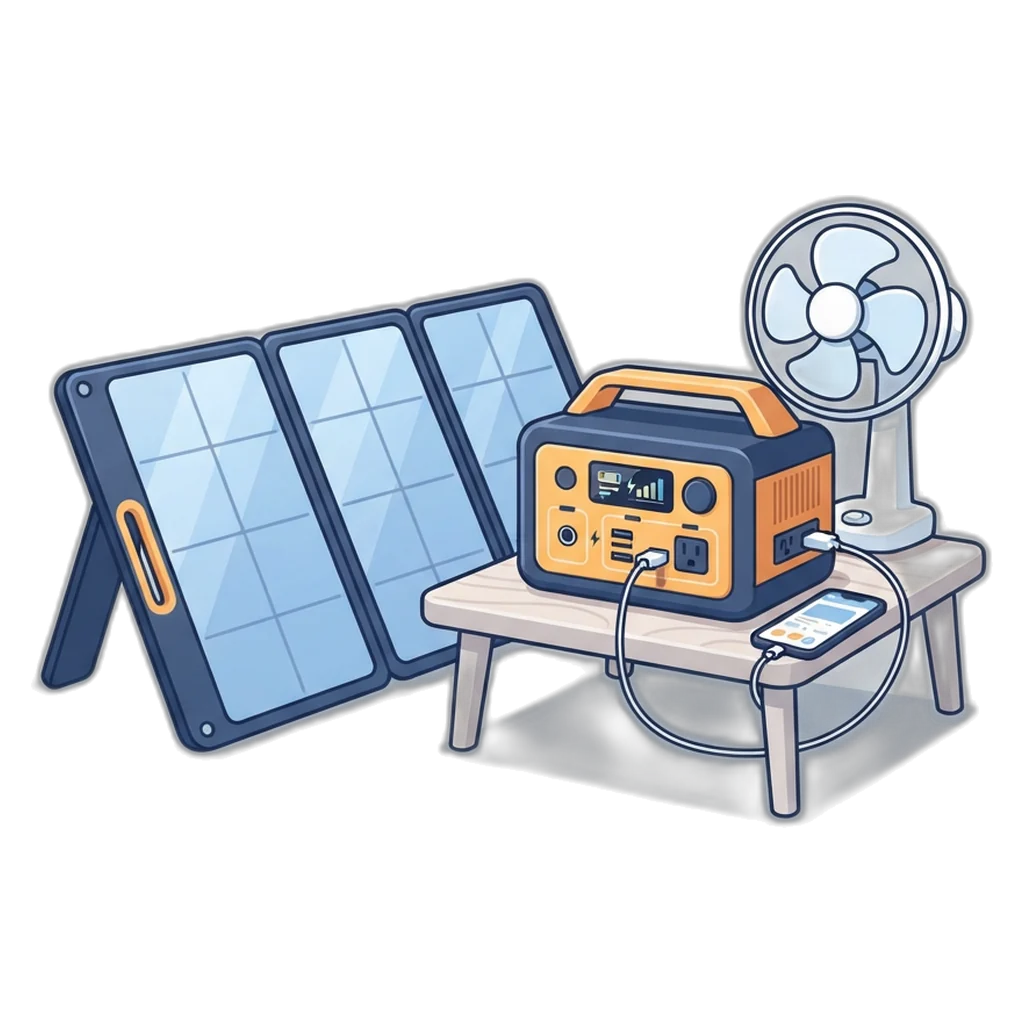
A portable power station is three things in one box: a battery, an inverter that turns battery power into household AC, and a charger. You charge it from a wall outlet, a car socket, or a folding solar panel. Then you plug appliances into its AC outlets, USB ports or 12 V socket.
A power station with solar panel means the box plus a panel sold as a set, often called a solar generator. The name is a little misleading. It does not generate power by itself like a gasoline genset. It only stores what you put in, and the panel is the part that turns sunlight into charge.
Capacity is printed in watt-hours (Wh): how much energy the battery holds. The AC output in watts (W) is the biggest load it can run at one time. Mixing them up is the most common buying mistake.
How it differs from a home solar system
A home system has roof panels, a hybrid inverter wired into your panel board, and a battery sized in kWh. Our home solar battery guide explains how those larger batteries are sized for nights and brownouts.
Why Filipinos look for portable power
Most buyers want a quiet answer to brownouts. A power station with solar panel charging needs no fuel, makes no fumes, and can sit inside the house. For a family in a condo or a rented home, it is backup power without drilling a roof or signing up with Meralco or the local electric cooperative.
Other reasons we hear often:
- Work-from-home and online classes that cannot stop when the power goes out.
- Keeping phones and a radio charged during typhoons, when outages can last days.
- Camping, fishing trips, events and small market stalls with no outlet nearby.
What it can run: the watt-hour math
Before you choose a power station with solar panel kit, add up the energy your loads need. The method is the same one we use for full systems: watts × hours = watt-hours. Check the label on each appliance for its watts; the numbers below are examples only.
| Load (example) | Example watts | Example hours | Energy used |
|---|---|---|---|
| Electric fan | 60 W | 8 h | 60 × 8 = 480 Wh |
| Wi-Fi router | 10 W | 8 h | 10 × 8 = 80 Wh |
| 3 LED bulbs | 3 × 9 W | 6 h | 27 × 6 = 162 Wh |
| Laptop | 50 W | 4 h | 50 × 4 = 200 Wh |
| Rice cooker (cooking cycle) | 600 W | 0.5 h | 600 × 0.5 = 300 Wh |
| Split-type aircon | 800 W | 8 h | 800 × 8 = 6,400 Wh |
Example values to show the method. Real wattage varies by model and setting; read the rating plate or manual.
Usable energy is less than the label
You never get the full Wh on the box at the AC outlet: the inverter loses some energy as heat.
Example: a 1,000 Wh station at an assumed 85% usable-to-AC gives 1,000 × 0.85 = about 850 Wh. A fan plus router draw 60 W + 10 W = 70 W, so 850 ÷ 70 = about 12 hours. That covers an 8-hour brownout with some margin, if nothing else is plugged in. The 85% is an assumption; your unit may differ.
Watch the watts, not only the watt-hours
The rice cooker in the table uses only 300 Wh, but it pulls 600 W while cooking. If the station’s AC output is rated lower than that, it will shut off even with a full battery. Motors in fridges, pumps and some fans also pull a short start-up surge above their running watts, so check the surge rating too.
Recharging from a folding solar panel
The solar side is what turns a battery box into a power station with solar panel backup that can last more than one night. A panel’s watt rating is its output under test conditions. On a real day in the Philippines, you get less because of heat, angle, dust and clouds.
Use this formula: panel watts × peak sun hours × overall factor = watt-hours per day. Peak sun hours in the Philippines are typically about 3.5–5 hours a day, depending on place and season. Look up your own city on the Global Solar Atlas. We use 4 hours and a factor of 0.75 in the examples below.
| Panel size (example) | Formula | Example Wh per day | Refill time for a 1,000 Wh unit |
|---|---|---|---|
| 100 W folding panel | 100 × 4 × 0.75 | about 300 Wh | about 3–4 sunny days |
| 200 W folding panel | 200 × 4 × 0.75 | about 600 Wh | about 2 sunny days |
| 2 × 200 W panels | 400 × 4 × 0.75 | about 1,200 Wh | about 1 sunny day, if the station accepts 400 W |
Example assumptions only. The station also caps how many solar watts and what voltage it accepts; extra panel watts above that cap are wasted.
Two practical points. The station decides how much solar it takes, so a bigger panel will not help past its input limit. And folding panels need full sun: even a window-grill shadow across part of the panel can cut output sharply.
On cloudy rainy-season days, expect much less. Charge from the wall whenever the grid is up.
Sizing by use
Here is a quick way to match a power station with solar panel set to what you actually need. Start with your must-run loads, not everything in the house. The Wh figures are examples built from the method above.
| Use | Example energy | What to look for | Fit for a portable? |
|---|---|---|---|
| Phones and LED lights | about 200–250 Wh per night (example) | Several USB ports, modest capacity | Yes, easily |
| Fan + router through an 8-hour brownout | 70 W × 8 h = 560 Wh (example) | Usable Wh above 560 plus margin | Yes, with a mid-size unit |
| Small fridge | Read the kWh/day on its energy label | AC output and surge above the compressor start-up | Possible for short outages; check surge |
| CPAP or other medical device | Ask your doctor and the device maker | Maker-approved battery or power source | Only with medical advice |
| Aircon | 800 W × 8 h = 6,400 Wh (example) | Installed system with a large battery | Not practical |
If someone in your home relies on powered medical equipment, plan backup with their doctor and the equipment manufacturer, not from a general guide.
If your list keeps growing past the fan and the fridge, it is a sign you need a home system. Our solar computation calculator turns your bill or appliance list into daily kWh, panel count and battery size in a few taps.
Portable brands you will see in the Philippines
When you shop for a power station with solar panel bundle, a few names come up often. EcoFlow, Anker, Bluetti and Jackery are well-known portable power brands. We do not list their specs or prices, because models change often.
Whichever brand you pick, buy from the maker's official channels or authorized resellers to get a real unit, a valid warranty and local service. Our guide to the best solar panel brands in the Philippines lists warranty checks that apply to portables too.
Be careful with:
- Listings with prices far below official channels, which can be fakes or gray-market imports.
- Capacity claims that do not match the label on the unit itself.
For electrical products, also check the DTI Bureau of Philippine Standards list of products under mandatory certification and look for PS or ICC marks where they apply.
Portable unit vs JH Solar home system
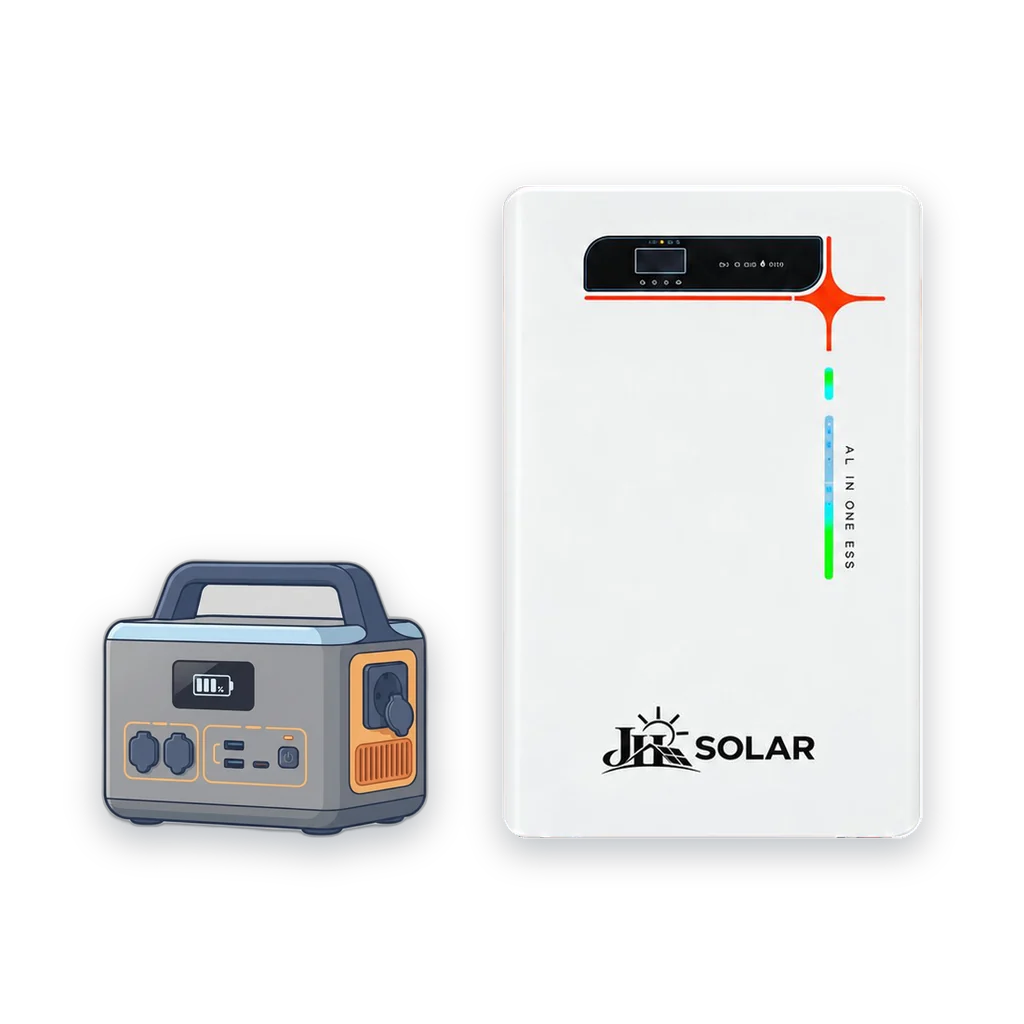
A power station with solar panel is portable backup for a few loads. An installed all-in-one system runs house circuits every day and cuts what you buy from the grid.
| Feature | Portable power station | JH Solar all-in-one (Version 1 / Version 2) |
|---|---|---|
| Capacity | Small; read the Wh on the label | Home-scale battery: V1 16 kWh, V2 15.36 kWh nominal |
| Solar array | One or two folding panels | Roof array: V1 6 × 620 W (3.72 kWp); V2 14 × 720 W (10.08 kWp) |
| Installation | None; plug and use | Floor-standing unit that can be moved (V2 on casters, about 160 kg); roof panels installed by licensed electricians |
| Aircon | Not practical | Possible, depending on the version and a site assessment |
| Whole-home brownout backup | No; only what you plug in | Yes, for the circuits the installer connects to backup |
| Daily bill savings | Very little | Can lower your bill; depends on your use, the sun and your rate |
| Expandability | Some models take extra battery packs | Planned at design stage with the installer |
| Price | Lower | Unit only: V1 ₱120,000, V2 ₱150,000; full system quoted after a site assessment |
| Permits | None | LGU electrical permit; utility steps if you apply for net metering |
JH Solar figures come from our product records. Unit prices cover the all-in-one unit only; panels, mounting, wiring, labor and permits are quoted after a site assessment.
When to step up to Version 1 or Version 2
We sell JH Solar Version 1 and Version 2, two all-in-one solar systems with the hybrid inverter and battery in one cabinet. They are our step up from a hand-carry power station: plug-and-play, floor-standing units that can be moved, and Version 2 rolls on casters (about 160 kg). Be realistic about the weight, and about the roof panels and wiring, which licensed electricians install as part of the package. We recommend them when a portable unit is too small for what you need.
Signs you have outgrown a portable unit
- You want to run aircon on solar, not just a fan.
- You want the whole house, or key circuits, to stay on during a brownout without plugging things in.
- You want daily savings on your electric bill, not only backup.
What each version offers
JH Solar Version 1 comes with 6 panels of 620 W each, for a 3.72 kWp array, and it is rated for a 7 kW inverter and a 16 kWh LiFePO4 battery (51.2 V, 320 Ah). Its one solar input takes up to 4,480 W, so it suits smaller daily use and night backup. Unit price: ₱120,000, unit only. Read the Version 1 specs and sizing page.
JH Solar Version 2 pairs 14 panels of 720 W (10.08 kWp) and is rated for an 11 kW inverter and a 15.36 kWh battery. Unit price: ₱150,000, unit only; see the Version 2 product page. Example: 15.36 × 0.80 usable × 0.90 efficiency ≈ 11.06 kWh to AC loads, or about 11 hours at a constant 1 kW. Those are example assumptions, not a promise of backup time.
Running an aircon is the most common reason people move up from a power station with solar panel. Our solar panel for aircon guide shows how panels, battery and inverter are sized for 1HP to 2HP units. You can read more about who we are on the JH Solar home page.
Buying checklist
If a portable unit fits your needs, check these points on the spec sheet before you pay.
- LiFePO4 battery. Lithium iron phosphate is the common chemistry for home solar storage and handles deep cycling well. See the lithium iron phosphate battery overview for the basics.
- Pure sine wave output. Fans, motors, chargers and sensitive electronics run cooler and quieter on pure sine wave AC than on modified sine wave.
- Continuous and surge rating. The continuous watts must be above your biggest load, and the surge rating must cover motor start-up.
- Solar input range. Check the maximum solar watts and the input voltage range. Your panel’s open-circuit voltage must stay inside it, or the unit may not charge or may be damaged.
- Warranty and local service. Ask who handles repairs in the Philippines and how long it takes.
- Ports and weight. Count the AC and USB-C ports you need, and lift the unit: you may carry it up stairs in the dark.
Benefits and limits
A power station with solar panel charging has real strengths and real limits.
Benefits
- No installation, no permits, and you can take it when you move.
- Silent and fume-free, so it can be used indoors with care.
- Solar refill keeps it useful through outages that last more than a day.
Limits and risks
- Small capacity compared with a home battery, so runtime is short for big loads.
- Folding panels give little energy on cloudy days and need to be set out and brought in.
- Little or no effect on your monthly electric bill.
- Heat shortens battery life, and many Filipino homes run hot in the afternoon.
On your phone
- Photograph each appliance rating plate, then use your phone’s calculator to add up watts × hours before you shop for a power station with solar panel.
- Many units have an app that shows input and output watts live; check it to see what your fan really draws.
- During brownouts, charge phones from USB ports, which waste less energy than an AC charger.
Typhoon and brownout season prep
A power station with solar panel is most useful when the weather turns bad. Prepare it before you need it, not during the storm. Follow the tropical cyclone wind signals from PAGASA so you know when to charge up.
- When a storm is forecast, charge the unit to full from the wall while the grid is still up.
- Keep the folding panel and cables dry and indoors during strong winds; a panel can become a flying object.
- After the storm passes, set the panel out in a safe, open spot to refill the station.
- Use power for essentials first: lights, phones, radio, then the fan.
Safety and Electrical Reminders
- Place your power station with solar panel kit on a hard, flat surface with space around its vents. Do not cover it, and keep it out of direct sun and away from stoves.
- Use the cables that came with the unit or rated replacements. Replace any cable with cracked insulation or a loose plug.
- Never connect a portable unit to a wall outlet or your panel board to power the house. Backup connection to home wiring is a job for a licensed electrician with a proper transfer switch.
- Keep folding panels and connectors dry. Do not handle wet connectors while the panel is in the sun.
- Stop using the unit if it swells, smells, hisses or gets unusually hot, and contact the official service center.
Solar panels make DC power whenever light hits them, and batteries hold enough energy to start a fire if they are shorted. Work on the grid side, the AC panel board or a net-metered system belongs to a licensed electrical practitioner following the Philippine Electrical Code. Our numbers are estimates, not a design or a quote.
Frequently Asked Questions
Can a power station with solar panel run a split-type aircon?
Not in a practical way. Example: an 800 W aircon running 8 hours uses 6.4 kWh, which is many times what a typical portable unit stores, and a folding panel cannot refill that in one day. A short run may be possible on a large unit, but for nightly aircon use an installed system with a bigger battery and a full roof array is the realistic option.
How long does a portable power station take to recharge from a solar panel?
It depends on panel watts, sun and the station's solar input limit. Use this example formula: panel W × peak sun hours × 0.75. A 200 W panel at 4 sun hours gives about 600 Wh a day, so a 1,000 Wh unit needs close to two good days. Clouds, shade and heat make it slower.
Can I use the power station while it is charging from the wall or the panel?
Many units allow this, often called pass-through charging, but not all of them, and some limit the output while charging. Read the manual for your exact model. Running loads while charging also adds heat, so keep the unit in a shaded, ventilated spot and do not cover its fans.
Is a portable power station better than a small gasoline generator during brownouts?
They suit different needs. A power station is quiet, makes no fumes and can be used indoors, but it runs out of stored energy. A gasoline generator can run longer if you have fuel, but it must stay outdoors because of carbon monoxide and needs regular upkeep. Many households pick by the loads they truly need.
Can I plug a portable power station into my house wiring or outlet?
No. Never feed power into a wall outlet with a male-to-male cable. It can push power back onto the line, endanger line workers and start a fire. Connecting backup power to a home panel needs a proper transfer switch or interlock installed by a licensed electrician following the Philippine Electrical Code.
What happens to a portable power station if I store it for months?
A power station with solar panel slowly loses charge even when switched off. Most manuals ask you to store it partly charged in a cool, dry place and top it up every few months. Check your model's manual for the exact advice, and test it before typhoon season so you are not surprised by an empty unit.
Conclusion: pick the size that matches the job
A power station with solar panel is a smart, simple buy for phones, lights, a fan and the router during a brownout, and for trips away from an outlet. Do the watt-hour math, check the solar input and surge ratings, and buy from official channels.
If you want aircon, whole-home backup or lower bills, a portable unit is the wrong size. That is where our all-in-one systems, Version 1 and Version 2, come in. Their unit prices are listed above; run your numbers, then ask for a site assessment and a written quote for the full system.
Outgrown your portable unit?
See what JH Solar Version 1 and Version 2 include, or size a home system from your electric bill first.
Related Guides
- JH Solar HomeStart here: JH Solar systems and every guide on one page.
- JH Solar ProductsOur two all-in-one units, side by side.
- Solar ComputationTurn your electric bill into a system size in a few taps.
- Solar Battery GuideHow much battery you need for nights and brownouts.
- Solar Panel for AirconRun your aircon on solar: panels, battery and inverter.