
Solar Panel Price Philippines Guide: What a Full Solar System Really Costs
Last checked · JH Solar guide
Checking the solar panel price Philippines sellers post online is usually the first step for anyone thinking about solar. The first question is almost always “magkano?” The panel price is easy to find, but it is only one part of what you pay. A working system also needs an inverter, often a battery, mounting, wiring, permits and labor.
This guide shows you how to read a panel quote using price per watt, what a full system quote includes, how to compare quotes and how to work out payback yourself. We do not list market prices, because they change with the peso-dollar rate and supply. Apart from our own unit prices near the end, every peso figure here is a labeled example to show the math.
Solar Panel Price Philippines Basics: Start With Price per Watt
Before you compare any solar panel price Philippines listing, turn it into price per watt. Panels come in many sizes, and price per watt puts them all on the same scale.
Why people search panel prices first
Type “how much is a solar panel in the Philippines” into a search bar and you get pages of per-piece prices. Panels are the most advertised part, so they feel like the whole cost. But without an inverter you cannot run home appliances, and without a battery you get no power at night or during a brownout.
How to compute price per watt
The formula: price per watt = panel price ÷ rated watts, using the watts on the label and datasheet.
Example only: a quote of ₱7,000 for one 720 W panel works out to ₱7,000 ÷ 720 W = about ₱9.72 per watt. This is not a market price; it only shows the math.
Next, work out how many panels you need from your daily kWh, peak sun hours and a loss factor. Example: 10 kWh a day ÷ (4 peak sun hours × 0.75) = 3.33 kWp. With 720 W panels, 3.33 ÷ 0.72 = 4.63, so you round up to 5 panels. Using the example price above, 5 × ₱7,000 = ₱35,000 for panels alone. You can size your system with our solar computation tool and change every assumption to match your home.

What Moves the Price of a Solar Panel
The solar panel price Philippines shops show depends on more than wattage. The table below lists the main factors and what each one means for your quote.
| Factor | How it affects the price | What to check |
|---|---|---|
| Wattage | Bigger panels cost more per piece but can cost less per watt, and fewer panels mean less mounting. | Price per watt, roof fit and the inverter input limits. |
| Cell type | Newer cell designs and bifacial panels usually cost more than older designs. | Cell type and efficiency on the datasheet. |
| Brand | Known brands with local distributors often cost more than unbranded panels. | A model number you can look up and a local distributor. |
| Warranty | Longer product and output warranties usually cost more. | Both terms in writing, and who handles claims locally. |
| Quantity | A full system or pallet often lowers the price per panel. | Whether the per-piece price drops with volume. |
| Freight and delivery | Large, fragile panels cost more to ship to provinces and islands. | Whether delivery and breakage cover are included. |
| Peso-dollar rate | Many panels sold here are imported, so a weaker peso can push prices up. | How long the quote stays valid. |
Qualitative guide only. Real prices change with supply and exchange rates; ask sellers for a dated, written quote.
Cell type is where sellers use the most jargon. Our guide to the different types of solar panels explains each design in plain words.
Cheap panels: benefits and risks
A low panel price can make solar possible on a tight budget, and for a small DIY kit a modest panel from a known seller may be enough. The risks: overstated watt labels, thin frames on a typhoon-prone roof, and warranties no one in the country will honor.
Why a Full Solar System Costs More Than the Panels
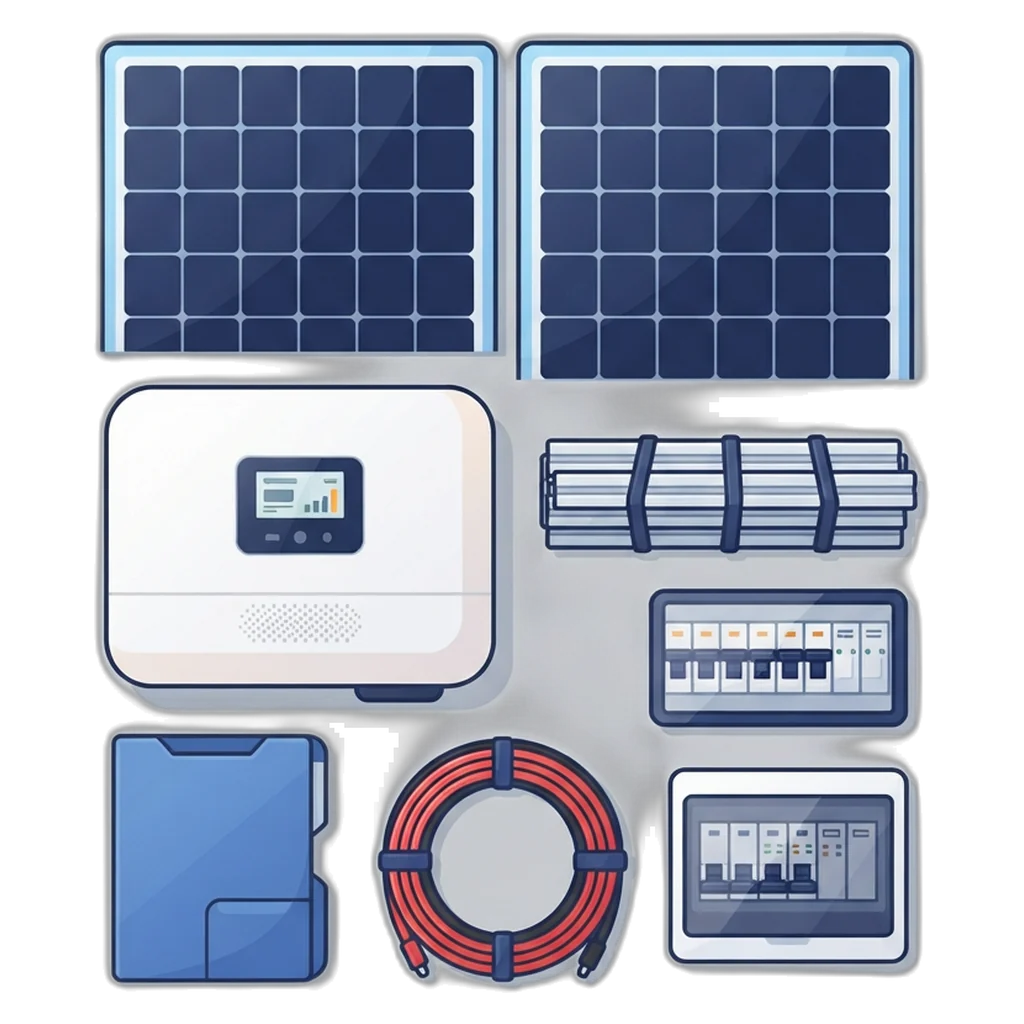
Many buyers stop at the solar panel price Philippines sellers post, but a full quote has many more lines, and the panels can be a smaller share of the total than buyers expect, especially with a battery.
| Line item | What it covers | What pushes it up | What can bring it down |
|---|---|---|---|
| All-in-one unit or inverter | Turns DC power into AC for your home; a hybrid unit also manages battery and grid. | Higher kW, hybrid design, more MPPT inputs. | Sizing to the loads you run at the same time. |
| Battery | Stores energy for night use and brownout backup. | More kWh, LiFePO4 chemistry, longer warranty. | Backing up only the loads you need. |
| Solar panels | Make DC power from sunlight. | More kWp, premium cells, small orders. | Larger panels, sizing to real daytime use. |
| Mounting | Rails, clamps, roof hooks and sealant. | Hard roof types, ground mounts, extra wind strength. | A simple, sound roof. |
| Electrical parts | PV cables, DC and AC breakers, surge protection, grounding. | Long cable runs, a backup panel board, old wiring. | Unit placed near the panels and panel board. |
| Contingency | An allowance for site surprises and small changes. | Old houses, unclear wiring. | A thorough site assessment. |
| Labor | Installation, testing and commissioning. | Steep or high roofs, remote sites. | Good roof access for the crew. |
| Permits and net metering | Electrical permit, inspections and the net-metering application. | Utility fees, meter changes. | No export, where the rules allow it. |
Not every quote lists every line. If one is missing, ask whether it is included, excluded or billed later.
The battery is often where quotes differ the most. Before you accept a battery size, read our solar battery sizing guide and check the usable kWh, not just the label.
How the System Type Changes the Cost
The same solar panel price Philippines buyers see can sit inside very different totals, depending on the type of system. The biggest difference is the battery: grid-tied systems have none, hybrid systems use one for night and backup, and off-grid systems rely on it for everything after sunset.
| System type | Battery share of the cost | Power during a brownout | Good fit for |
|---|---|---|---|
| Grid-tied | None; usually the lowest total. | No. The inverter shuts down to protect line workers. | Lower daytime bills where outages are rare. |
| Hybrid | Medium; sized for night use or chosen backup loads. | Yes, for backup-circuit loads while the battery has charge. | Frequent brownouts, with grid and net metering kept. |
| Off-grid | High; covers every night and cloudy days. | No grid; battery and panels carry all loads. | Farms and remote homes far from a power line. |
Order of battery share: grid-tied < hybrid < off-grid. Actual totals depend on sizing and parts.
If you want backup and still want your utility connection, a hybrid system is the usual middle ground. The how hybrid systems connect shows how panels, battery, grid and backup loads connect, and why a hybrid quote has more parts.
Paying for Solar: Cash, Loans and Installments
Many families cannot pay for a full system in one go, so how you pay is part of the real solar panel price Philippines households face. There are three common routes: cash, a loan and an installment plan.
- Cash. The simplest route. Never pay in full before delivery without a written contract.
- Loans. Some lenders may allow a loan, such as a home improvement loan, to be used for solar. Programs and rules change, so ask your bank or any government fund you belong to what is available now.
- Installments. Credit card installments or seller payment plans spread the cost. Check whether the plan adds interest or fees.
To compare a plan with cash: total paid = monthly payment × months + fees. The difference from the cash price is the true cost of financing; add it to the system cost when you work out payback.
How to Compare Solar Quotes Line by Line
Two quotes with a similar total can describe very different systems. To compare a solar panel price Philippines quote fairly, put each one through the same checklist. A seller who cannot answer in writing is a warning sign.
| Question to ask | Why it matters | Warning sign |
|---|---|---|
| Same kWp? | Panel count × panel watts sets how much energy the system makes. | Panel count listed with no wattage. |
| Same battery usable kWh? | Usable kWh, not nominal, is what runs your loads at night. | No kWh stated, or only "big battery" or "long backup". |
| Brand and model named? | You can only check a datasheet and warranty if you know the exact model. | "Tier 1", "grade A" or "imported" with no model number. |
| Warranty in writing? | Panels, inverter, battery and workmanship each have their own warranty. | A verbal promise, or no local office to claim from. |
| Permits included? | Electrical permits and inspections are part of a legal install. | The seller says permits are "not needed" for a grid-connected system. |
| Net metering included? | Exporting to the grid needs approval from your utility. | Unclear who files the application or pays the fees. |
Put each quote in a column and tick the answers. Compare totals only after the systems match.
The installer matters as much as the parts. Our guide to choosing solar installers in the Philippines lists what to ask about licenses and after-sales support.
Solar Payback: How to Work It Out Yourself
After the solar panel price Philippines sellers quote, the next question is payback: how many years until the energy you get from solar equals what you paid? You can work it out with two numbers. Be careful with any seller who quotes a fixed payback period; real results always vary.
Payback (years) = total system cost ÷ yearly value of the solar energy you use. The yearly value is the solar kWh you use (or get credit for) in a year, multiplied by your rate per kWh.
| Step | Formula | Hypothetical example |
|---|---|---|
| 1. Solar energy used each day | From your sizing or the installer’s estimate | Assume 10 kWh a day |
| 2. Solar energy used each year | Daily kWh × 365 | 10 × 365 = 3,650 kWh |
| 3. Your rate per kWh | From your bill (it changes monthly) | Assume ₱12 per kWh |
| 4. Yearly value | Yearly kWh × rate | 3,650 × ₱12 = ₱43,800 |
| 5. Total system cost | Quote total + financing cost | Assume ₱300,000 |
| 6. Payback | Cost ÷ yearly value | ₱300,000 ÷ ₱43,800 ≈ 6.8 years |
Hypothetical numbers chosen only to show the math. They are not a quote, a rate forecast or a promised result.
Why your real payback will differ
- Rates change. Your rate per kWh moves month to month, so the yearly value moves too.
- Use versus export. Energy you use at home saves the full rate. Energy exported under net metering may be credited at a different, often lower, rate than the one you pay; check the current rule with your utility.
- Weather and aging. Rainy months, shade, battery losses and slowly aging parts lower the value over time.
Brownout backup has value too, even if it does not show in the formula. Only you can decide what a cold fridge and a working fan during an outage are worth.
JH Solar Unit Prices: Version 1 and Version 2
JH Solar offers two all-in-one systems, where the hybrid inverter and the battery sit in one cabinet. As of October 2026, these are the unit prices. They cover the all-in-one unit only.
| Unit | Rated for | Panels | Unit price |
|---|---|---|---|
| Version 1 | 7 kW inverter, 16 kWh battery | Up to 6 (6 × 620 W = 3.72 kWp) | ₱120,000 |
| Version 2 | 11 kW inverter, 15.36 kWh battery | 14 × 720 W = 10.08 kWp | ₱150,000 |
Unit only; panels, mounting, wiring, labor and permits are quoted after a site assessment.
A full JH Solar package covers these parts:
- All-in-one unit (hybrid inverter and battery in one cabinet)
- Solar panels
- Mounting rails and roof hardware
- Electrical parts: PV cables, DC isolators and breakers, surge protection, AC breaker, grounding
- Labor: installation and commissioning
We do not post a whole-setup total. Like any solar panel price Philippines quote, the rest of the system is priced after a site assessment, because roof type, cable distance, wiring condition and permits change the cost from one house to the next. See the full comparison of JH Solar Version 1 and Version 2, or the Version 2 product page, then ask us for an assessment. Payment options: Bank transfer, GCash, Maya, Cash.
Philippine Context: Rates, Brownouts, Heat and Typhoons
Local conditions shape the solar panel price Philippines homes end up paying, and the value they get back. Here is what to keep in mind.
- Electricity rates. The rate per kWh on your Meralco or electric cooperative bill changes monthly. See the Department of Energy’s electricity rate data for the Philippines.
- Brownouts. Where outages are frequent, a battery adds value a grid-tied system cannot give.
- Peak sun hours. Most places get about 3.5–5 peak sun hours a day, depending on location and season. Check your city on the Global Solar Atlas before you size panels.
- Heat, rain and typhoons. Panels make less power when very hot and in the rainy season, and mounting must suit typhoon wind loads. Stronger rails cost more but protect the whole system.
- Net metering. Meralco’s net metering FAQ lists a ₱1,500 application and processing fee and caps the residential meter-cost charge at ₱3,000 (as of October 2026). Electric cooperatives set their own process, so check the current requirements with your utility.
On Your Phone: Getting Quotes by Chat
If you ask about the solar panel price Philippines sellers offer through a chat app, send the right photos and details from your phone so the first estimate is closer to the final quote.
- Roof photos. A wide shot of the whole roof, a close-up of the roofing and any trees or buildings that cast shade.
- Bills. Send photos of several recent bills showing the kWh used, not just the peso amount.
- Panel board and location. A photo of your main panel board and a map pin help plan wiring and delivery.
- Ask for a PDF. Request an itemized, dated quote, not a price typed in chat.
- Protect yourself. Pay no deposit until you know who the seller is and have the terms in writing.

Safety and Electrical Reminders
- Cheap, unknown parts. No-name breakers, thin cables and fuses without DC ratings can overheat. Ask for the brand and rating of each one.
- Fake ratings. Some panels, batteries and inverters carry labels that overstate watts, kWh or certifications. Ask for the datasheet, and check the DTI-BPS list of products under mandatory certification and look for PS or ICC marks where they apply.
- Installer licensing. Grid-connected and AC-side work must be done by a registered master electrician (RME) or professional electrical engineer (PEE) following the Philippine Electrical Code, published by the Institute of Integrated Electrical Engineers of the Philippines.
- Do not cut safety items to save money. Grounding, surge protection and proper breakers are not optional extras.
- Storm-ready mounting. A weak mount can turn panels into flying debris in a typhoon. Check the mounting after every strong storm.
Solar panels make DC power whenever light hits them, and batteries hold enough energy to start a fire if they are shorted. Work on the grid side, the AC panel board or a net-metered system belongs to a licensed electrical practitioner following the Philippine Electrical Code. Our numbers are estimates, not a design or a quote.
Frequently Asked Questions
Why do quotes for the same panel wattage differ so much between sellers?
Panels with the same watt rating can differ in cell type, brand, warranty and frame strength, and sellers add different margins and delivery costs. For a fair solar panel price Philippines comparison, ask each seller for the brand, model and datasheet, then compare price per watt.
Is a lower price per watt always the better deal?
Not always. A cheaper panel with an unclear warranty, an overstated rating or a weak frame can cost more later if it fails and has to be replaced. Compare price per watt only between panels with similar warranties, datasheets and seller support.
Does a solar panel price Philippines quote usually include permits and net metering?
It depends on the seller. Some quotes cover only parts, while others include labor, the electrical permit, inspection papers and the net-metering application. Ask the seller to list in writing which permits and fees are included and which ones you must handle yourself.
Is it cheaper to buy a solar system in stages?
Buying in stages spreads the cost, but it is not always cheaper overall. Labor and permits may be paid twice, and later parts must match the first ones. If you plan to add panels or a battery later, choose a unit with room for the extra input now.
Are there government loans for solar panels in the Philippines?
Loan programs and their rules change over time, so this page does not name any. Ask your bank, or any government fund you are a member of, whether a current loan (such as a home improvement loan) can be used for solar, then compare the total you will repay with the cash price before you sign.
How do I estimate payback when my electricity rate keeps changing?
Use the average rate per kWh from several recent bills, then run the payback math again with a lower and a higher rate. This gives you a range instead of one number. Treat every result as an estimate, because rates, usage and weather all change.
Conclusion: Look Past the Panel Price
The solar panel price Philippines sellers advertise is a useful starting point, but it is only one line in a full quote. Turn every panel price into price per watt, then look at the inverter, battery, mounting, wiring, labor and permits. Compare quotes only when the systems match in kWp, usable battery kWh, named brands and written warranties.
Work out payback with your own bill and rate, and treat the result as an estimate, not a promise. Size your needs first, then use this solar panel price Philippines checklist to ask for an itemized quote and a site assessment.
Get your numbers before you get a quote
Work out your daily kWh, panel count and battery size from your bill, then ask JH Solar for a site assessment and a written quote.
Related Guides
- JH Solar HomeStart here: JH Solar systems and every guide on one page.
- Solar ComputationTurn your electric bill into a system size in a few taps.
- JH Solar ProductsOur two all-in-one units, side by side.
- Solar Battery GuideHow much battery you need for nights and brownouts.
- Best Solar Panel BrandsPanels, inverters and batteries: what makes a brand good.
- Solar Panel InstallationWhat happens on install day, and what comes before it.